
Resetting the Nervous System: From the Cardiac OR to the Somatic Sanctuary


Six sets of laundry. A kitchen table buried under school folders, old mail, and drying artwork. The relentless, rhythmic hum of a household of eight.
This is my current everyday reality.
As a mother to six children, my days are a balancing act in managing beautiful, chaotic over-stimulation, where the ambient noise of a busy family is constantly testing my own nervous system's capacity to stay grounded. Long before I learned to anchor a home or curate a peaceful wellness space, however, my baseline was forged in an environment where the stakes were vastly different, yet the demand for absolute stillness was exactly the same. Managing a large family teaches you that human beings do not thrive in continuous chaos. We require structural boundaries and intentional pauses to prevent our internal systems from permanently fracturing under the weight of daily demands.
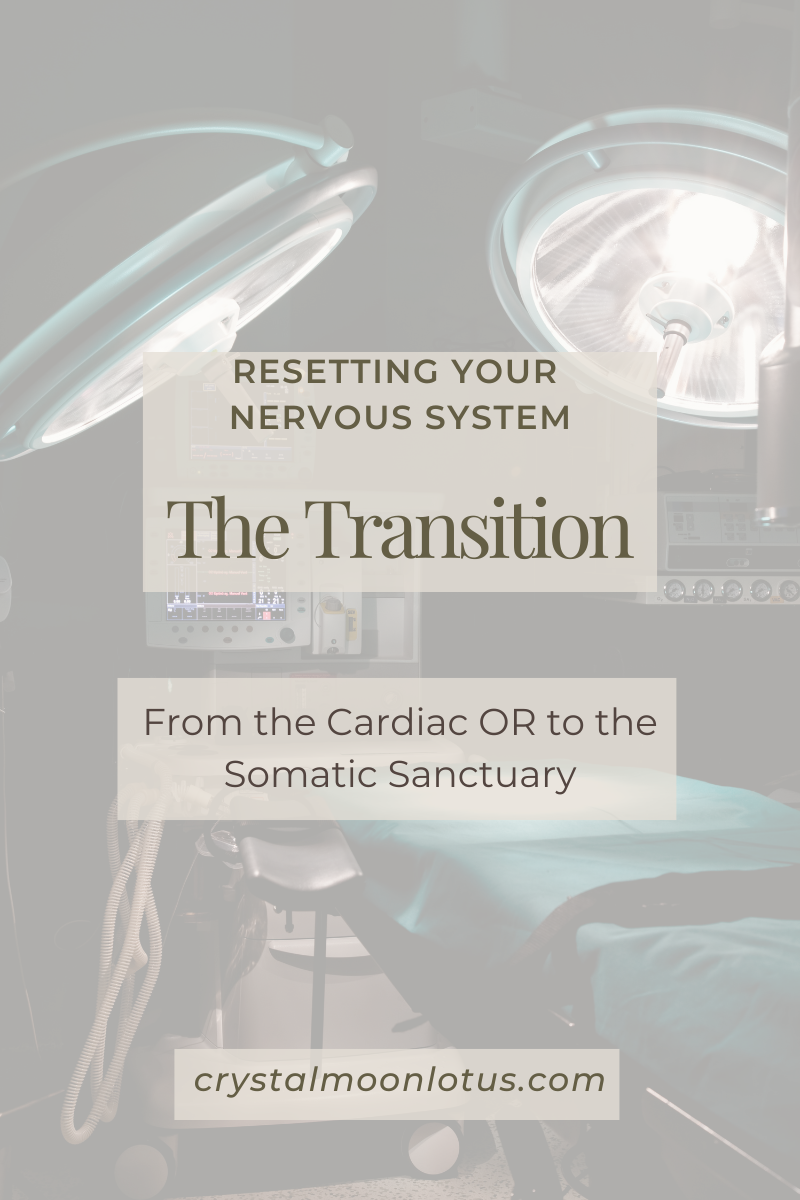
The precise foundation of that internal control was something I lived every single day during my previous career as a cardiac surgical technologist. In the high-stakes environment of a major hospital operating room, there is no margin for energetic interference or ungrounded panic when a human heart is stopped on the table. My hands operated in a sterile field governed by rules, where the ambient noise of monitors, the sharp glare of surgical lights, and the dense, pressurized atmosphere demanded that I maintain an unshakeable, steady baseline for the safety of the patient. In surgery, you quickly learn that the human body under trauma relies entirely on the stability of the team surrounding it to navigate the crisis and return to baseline.
Now, as the founder of Crystal Moon Lotus, I have taken that exact, disciplined approach out of the sterile operating theater and built a somatic sanctuary designed to help overextended individuals rebuild their own resilience. You do not need to wait for a physical crisis or a surgical intervention to step out of a high-stress lifestyle. The true work of somatic recovery begins when you intentionally restructure your immediate environment, stripping away visual and auditory clutter so your brain can finally stop defensive processing. By maintaining a private, low-stimulus space, we can consciously down-regulate the autonomic nervous system and invite the body back into a natural state of active cellular repair.

Every mother knows the exact physical sensation of running on pure adrenaline when the household demands reach a boiling point all at once. You can feel your chest tighten, your breath grow shallow, and your mind begin to swirl as you try to process fifteen competing questions while just trying to cook dinner. This is the exact moment where the modern world tells you to just "breathe through it" or try harder to ignore the noise. But trying to force a mental shift while your external environment is still screaming at you is a biological mismatch that only deepens your exhaustion. Your body is reacting precisely how it was designed to. It is interpreting a chaotic environment as an active threat.
In the cardiac OR, when a patient is placed on cardiopulmonary bypass, the mechanical flow of blood must be perfectly steady, and the room’s ambient variables are controlled to minimize cellular stress. This clinical process aligns completely with Polyvagal Theory, which says that our autonomic nervous system is continuously scanning our environment for cues of safety or danger through a process known as neuroception. Research published in Frontiers in Integrative Neuroscience highlights that when our environment floods us with unpredictable or excessive sensory data, the nervous system gets locked into a continuous fight-or-flight survival loop, completely halting the body's natural restorative functions.
To break that survival loop at home, you have to stop treating relaxation as a mental exercise and start treating it as an environmental design. You must intentionally build a physical sensory gating practice into your daily routine by deliberately eliminating visual and auditory tracking for a set period of time. Start by identifying one small corner of your home, turning off all overhead fluorescent or bright white lights, and silencing your digital devices completely. By replacing that erratic environmental data with a single, predictable sensory anchor, such as a subtle, grounded essential oil or a low-intensity warm lamp, you send an immediate, unmistakable signal to your optic nerve that your brain can safely stop scanning for threats.

Reflecting on my twenty-year marriage and the journey of raising six children, I see clearly that the most profound shifts in our family dynamic don't really come from loud lectures or forced control. They came from the quiet moments when I choose to lower my own vocal cadence, soften my posture, and become the steady anchor in a room full of emotional weather. Children are incredibly sensitive mirrors of the energetic field around them. If the adults of the home are operating on empty, vibrating at the frequency of chronic exhaustion, the entire structure of the household absorbs that tension and begins to dysregulate in tandem.
This collective stabilization is a concept deeply rooted in the physical and biological sciences I relied upon during my years in surgery. The cells within our tissues require a coherent, stable frequency to maintain health and communication. When a pure, sustained acoustic frequency is introduced to a chaotic environment, a physical principle called entrainment occurs, causing the erratic internal rhythms of the body, like a racing heart rate or disorganized brainwaves, to naturally slow down and synchronize with the steady external baseline. A study in the International Journal of Environmental Research and Public Health confirmed that targeted sound frequencies directly stimulate the vagus nerve, actively increasing heart rate variability and shifting the body out of sympathetic overdrive into parasympathetic dominance.
Resetting your nervous system doesn't require you to buy any special wellness equipment or master a complex meditation technique. Your body already has its own built-in off-switch, and you can activate it the moment the room around you gets too loud. When you feel your stress levels rising, find a quiet corner, lie flat on your back, and let the floor fully support your weight so your muscles can stop holding tension. Place one hand on your chest and one on your belly, and just focus on making your exhales slightly longer than your inhales. This simple physical shift immediately signals your nervous system that the rush is over, dropping your heart rate and putting you back in control of your own day.

Ultimately, the shift from a high-stress OR job to raising a busy family taught me the exact same lesson: you can't just force yourself to power through a chaotic day. True recovery begins when you stop fighting the noise and give yourself a real break. Whether you are dealing with a demanding career, a hectic household, or just the constant rush of everyday life, your body needs a quiet space to finally relax. By intentionally stepping away from the non-stop screen time and daily demands, you aren't giving up. You are just giving your body a chance to catch its breath, recharge your battery, and finally get back to normal.
References
Frontiers in Integrative Neuroscience. Neuroception and the Polyvagal Theory: How the Autonomic Nervous System Shapes Our Sensory Processing and Emotional Regulation.
International Journal of Environmental Research and Public Health. The Impact of Low-Frequency Sound Stimulation on Vagal Nerve Activity and Heart Rate Variability in Stressed Populations.

Comments